Five Rug Shapes That Fix Britain's Most Awkward Living Rooms (Bay Windows Included)
British homes are full of architectural leftovers. A bay window bolted on by a Victorian who liked a view. A chimney breast jutting into the room like an afterthought. A hallway long enough to bowl down. All charming, all completely baffling when you are standing in a shop holding a tape measure.
The good news is that most of these problems are solved by shape rather than size or spend. Here are five of the most common awkward layouts, what rug fixes them, and the measurements that stop you ordering something that has to go back.
1. The bay window that swallows your sofa
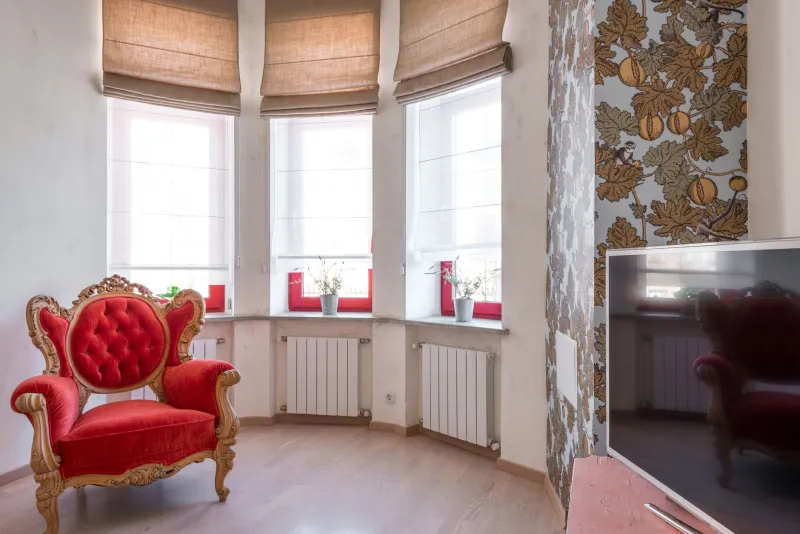
The problem: a bay creates a curved pocket of floor that a standard rectangular rug can never quite meet. Line the rug up with the straight walls and you leave a sad crescent of bare boards inside the bay; push it into the curve and the back corners ruck up against the skirting.
The fix: a round or oval rug inside the bay itself, treated as its own little zone. It echoes the curve instead of fighting it, and it makes a lovely spot for a reading chair or a plant. Alternatively, turn a rectangle so it runs across the bay rather than into it — a trick that works well when the bay is shallow.
Sizing: measure the widest point of the bay at floor level, then go 20–30cm narrower so the edges sit clear of the skirting. A 120cm or 160cm round covers most domestic bays; go oval if the bay is wider than it is deep.
2. The chimney breast and its two orphan alcoves
The problem: the breast sticks out 30–40cm and the alcoves either side are rarely the same width. Furniture lined up along the back wall leaves two thin strips of bare floor and a room that reads as permanently unfinished.
The fix: two matching small rectangular rugs, one per alcove. Treat each alcove as its own micro-zone — a chair, a lamp, a rug. It is a genuinely clever way to make an awkward recess look deliberate, and because you are buying two small pieces rather than one enormous one, it stays affordable.
Sizing: 80x150 or 120x170 suits most alcoves. Leave a visible border of floor — around 10–15cm — on all sides so the rug looks placed rather than wedged in. Buy both at the same time from the same range; dye lots vary more than you would think.
3. The hallway that is basically a corridor
The problem: long and narrow, with doors along one side. A square rug looks daft, a big rectangle trips people up, and bare boards make the whole entrance feel cold the moment you step in.
The fix: a runner. It is the least glamorous purchase in the shop and the one you will be happiest with. Standard sizes are 66x200, 80x240 and 80x300 — measure the clear floor between the skirting boards first, then pick the closest.
Sizing: aim for a 10cm gap of visible floor on each long side, and stop the runner 30–45cm short of each doorway so the door swings clear. Keep the pile low; a deep shag in a hallway is a trip hazard waiting to happen.
4. The through-lounge (two rooms knocked into one)
The problem: the classic Victorian conversion. You now have a very long, fairly narrow space with a sofa at one end and a dining table at the other, and a single rug either looks lost in the middle or disappears under furniture.
The fix: two identical rugs, one anchoring each zone. Same size, same fibre, same colour — the repetition is what makes it read as intentional rather than as two random rugs. If the space is very narrow, a single long runner down the centre can work instead, but only if the furniture sits close to the walls.
Sizing: each rug should reach at least the front legs of the seating in its zone. 160x230 is the workhorse size here; 120x170 works if the space is tight.
5. The box room with a radiator and a door that swings in
The problem: small, square, one radiator, one door, and no floor left once you add a bed or a desk. A rectangular rug crowds the longest wall and makes the room feel narrower than it is.
The fix: a square rug. Square shapes calm a boxy room because they mirror the footprint instead of fighting it. Keep it off the walls, though — a wall-to-wall look in a small room makes it feel like a padded cell.
Sizing: measure the shortest wall-to-wall distance, then subtract 40–60cm. In a 3m x 3m room, a 160x160 square leaves a generous border and still gives you somewhere soft to stand. Check the radiator clearance and the door swing before you commit.
Sizing rules that save you a return
- Measure the floor, not the walls. Skirting boards eat 2cm at every edge.
- Leave a consistent border — 10–20cm in living rooms, more in small rooms.
- Front legs of the sofa on the rug is the safe rule of thumb; all four legs on is the luxurious one.
- Check door swings and radiator positions before ordering, not after.
- When in doubt in a living room, go bigger. Too small is the single most common rug mistake.
Renter-friendly practicalities
None of these fixes require a drill, glue or permission. A good anti-slip pad does the work instead, and it protects the landlord's flooring from scratches at the same time — which is exactly the sort of thing that gets a deposit back. Stick to mid-weight rugs you can roll up and carry, and if you are buying for an alcove or a bay you may only be in for a year, remember that two small rugs travel far more easily than one large one.
Awkward architecture is not a problem to hide. Get the shape right and it becomes the most interesting thing in the room.